6th Edition Test Content Outline
BCBA 6th Edition Test Content Outline: 9 Domains
The BACB publishes the Test Content Outline, not a passive checklist. Domain counts and weights below come from the official 6th Edition document; study tips are editorial guidance from Behavior School.
Start free BCBA practice
- Nine official TCO domains (A–I)
- 175 scored questions on the BCBA exam
- Linked to BACB source documents
What changed from the 5th Edition task list, and why it matters for study order
The 6th Edition Test Content Outline uses nine lettered domains, A through I, and the BACB publishes the scored-question weight for each domain in the official PDF linked below.
The exam delivers 175 scored items plus unscored pilot questions in a four-hour session, per the BACB. Behavior Study Tools reports practice and mock performance by the same domain labels so you can align retrieval practice with those official weights.
Reading the PDF alone rarely transfers to exam items. Each domain card below lists the official weight, editorial study tips, and a one-week study block. The guidance is clearly separate from BACB task wording.
Official weights: BACB Test Content Outline (6th ed.) PDF. Editorial tips: Behavior School study guidance only.
Official structure
How the BACB organizes the 104 tasks across nine domains
Per the official 6th Edition outline: Domain B (Concepts and Principles) and Domain G (Behavior-Change Procedures) each contribute 14% of scored items. Domains C, E, F, and H each sit between 11% and 13%. Domain D (Experimental Design) is 7%, and Domain A (Philosophical Foundations) is 5%.
That distribution means equal calendar time per domain is usually inefficient. Candidates with strong coursework in concepts still need deliberate reps in supervision, intervention selection, and assessment because those domains carry multiple questions per task.
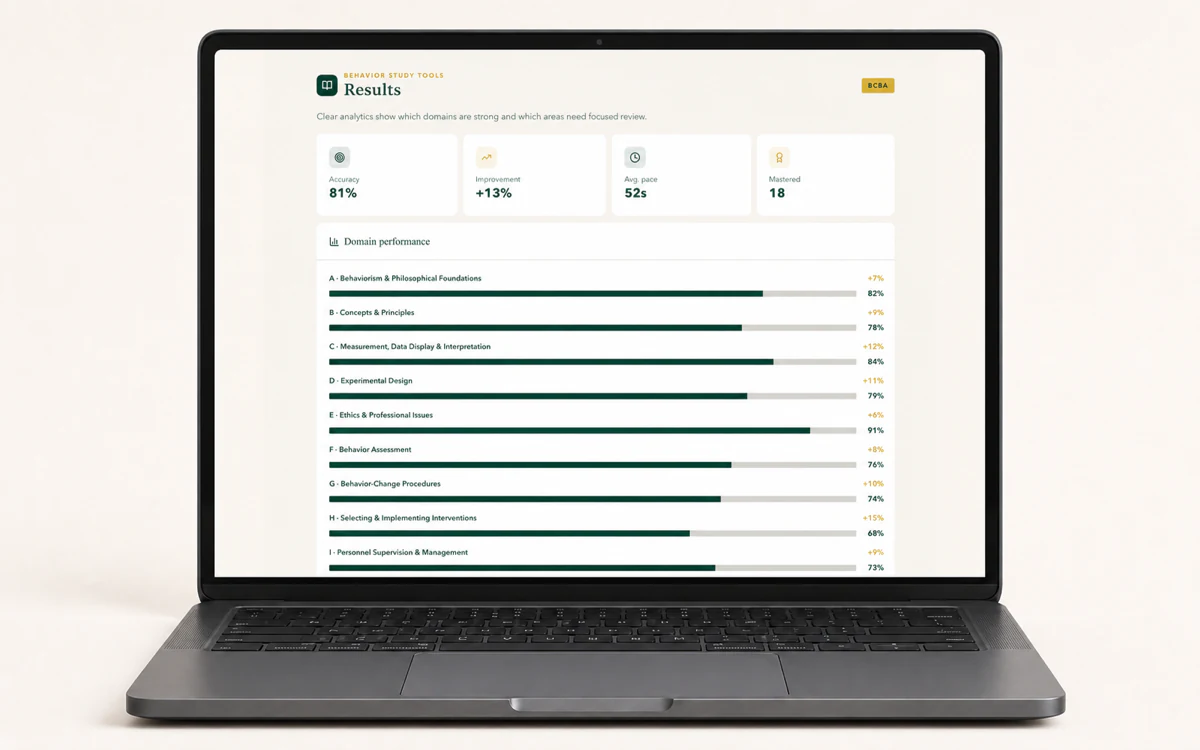
Behavior Study Tools organizes practice sets and mock results by domain so you can compare your accuracy pattern to these official weights, not guess from one overall percentage.
Study loop
Turn each domain row into a weekly practice assignment
Start with a Quick domain check, nine questions, one per domain, to surface domains that may deserve a closer look. That is not a complete weakness ranking from nine items alone, and it is not the same as a baseline from a finished full 185-question mock or a completed domain mini mock.
Assign one primary domain per week based on need, not alphabet order. Add mixed timed sets once single-domain accuracy improves. Schedule full mocks only when you need pacing evidence across all nine domains.
After each block, write one sentence on why the correct answer beat the best distractor. That habit matters most in Ethics, Assessment, and Intervention Selection where two answers often look acceptable.
- Quick domain check for orientation
- One primary domain focus per week
- Mixed timed sets for transfer
- Full mock for pacing across domains
- Rationale notes on missed items
Why this page stays here
Why this TCO guide lives on behaviorstudytools.com
We redirected the schedule and school BCBA landers because BehaviorSchool already owns those canonical topics.
This outline guide stays on the marketing site to map official BACB domains to Behavior Study Tools practice labels, a distinct search intent from schedule planning or school-context product pages on behaviorschool.com.
BCBA 6th Edition Test Content Outline: all nine domains
Official domain counts from the BACB PDF linked in Sources. Study tips are editorial.
Domain A: Behaviorism and Philosophical Foundations
8 questions, 5% of exam
- Editorial study tip: distinguish behavior-analytic assumptions from mentalistic explanations.
- Editorial study tip: explain how selection by consequences differs from a circular explanation.
- Editorial study tip: connect philosophical assumptions to observable study decisions.
How to study Domain A this week
Define the field's assumptions in your own words, then complete a short mixed set and explain why each distractor is less behavior analytic.
Practice this domain
Domain B: Concepts and Principles
24 questions, 14% of exam
- Editorial study tip: apply reinforcement and punishment to consequences, not intentions.
- Editorial study tip: contrast stimulus control with motivating operations in short vignettes.
- Editorial study tip: draw a three-term contingency before choosing an answer.
- Editorial study tip: explain why a consequence changed future behavior.
How to study Domain B this week
Build a one-page comparison of reinforcement, punishment, motivating operations, and stimulus control. Finish with applied questions and rationale notes.
Practice this domain
Domain C: Measurement, Data Display, and Interpretation
21 questions, 12% of exam
- Editorial study tip: choose measurement systems from the behavior and decision need.
- Editorial study tip: practice graph selection and visual analysis before calculations.
- Editorial study tip: calculate and interpret IOA, not just memorize formulas.
- Editorial study tip: identify when a measure could obscure meaningful change.
How to study Domain C this week
Review one measurement system, one graph, and one IOA method. Then interpret a small data display and state the clinical decision it supports.
Practice this domain
Domain D: Experimental Design
13 questions, 7% of exam
- Editorial study tip: match the design to the practical question and ethical constraints.
- Editorial study tip: identify the independent variable and demonstration of control.
- Editorial study tip: compare reversal, multiple-baseline, and alternating-treatments logic.
How to study Domain D this week
For three short research questions, name the design, the demonstration of control, and one limitation. Check your reasoning against the TCO tasks.
Practice this domain
Domain E: Ethical and Professional Issues
22 questions, 13% of exam
- Editorial study tip: identify the relevant Ethics Code duty before proposing action.
- Editorial study tip: choose the least burdensome effective response that protects clients.
- Editorial study tip: practice documentation, competence, supervision, and multiple relationships scenarios.
- Editorial study tip: separate a defensible process from an appealing outcome.
How to study Domain E this week
Work through five ethics scenarios. For each, write the duty, the immediate risk, the consultation or documentation step, and the next action.
Practice this domain
Domain F: Behavior Assessment
23 questions, 13% of exam
- Editorial study tip: distinguish indirect, descriptive, and functional assessment methods.
- Editorial study tip: match assessment data to the decision that must be made.
- Editorial study tip: practice identifying antecedent, behavior, and consequence patterns.
How to study Domain F this week
Classify five assessment examples by method, then state what each method can and cannot establish before selecting a next step.
Practice this domain
Domain G: Behavior-Change Procedures
25 questions, 14% of exam
- Editorial study tip: distinguish antecedent strategies from consequence-based procedures.
- Editorial study tip: connect skill-acquisition procedures to prompting, fading, and generalization.
- Editorial study tip: choose behavior-reduction procedures with client safety and function in view.
- Editorial study tip: explain the mechanism, not just the procedure label.
How to study Domain G this week
Take one target behavior and write a function-linked plan with an antecedent strategy, teaching procedure, consequence, and generalization check.
Practice this domain
Domain H: Selecting and Implementing Interventions
20 questions, 11% of exam
- Editorial study tip: match intervention selection to assessment results and client context.
- Editorial study tip: include feasibility, acceptability, cultural responsiveness, and risk.
- Editorial study tip: practice monitoring fidelity and outcome data after implementation.
- Editorial study tip: plan for maintenance, generalization, and modification.
How to study Domain H this week
Compare two plausible interventions for one case. Choose the stronger option using evidence, feasibility, acceptability, risk, and a monitoring plan.
Practice this domain
Domain I: Personnel Supervision and Management
19 questions, 11% of exam
- Editorial study tip: connect supervision plans to observable trainee performance.
- Editorial study tip: practice behavioral skills training, feedback, and competency checks.
- Editorial study tip: include documentation, delegation, and scope of competence.
- Editorial study tip: apply organizational behavior management to systems-level barriers.
How to study Domain I this week
Draft a supervisor's plan for one skill: define performance, model it, rehearse it, give feedback, and set a competency check.
Practice this domain
Connect each TCO domain to your next practice block
Behavior Study Tools maps questions and mock results to the same A–I domain labels in the official outline.
01 Confirm tasks in the official PDF
Download the current BCBA Test Content Outline from the BACB and skim task verbs, not only domain titles.
02 Practice with domain scoring
Answer applied questions and review which domains underperform relative to official exam weight.
03 Adjust weekly focus
Move study time toward high-weight domains where your accuracy still lags.
Start free BCBA practice
TCO and task-list questions from BCBA candidates
Where do I download the official 6th Edition outline?
Use the Test Content Outlines page on bacb.com and download the BCBA Test Content Outline (6th ed.) PDF. Linked on this page for verification.
Is the task list the same as the test questions?
No. Tasks describe content the exam may cover; individual items are scenario-based. You still need applied questions and explanation review for each domain.
Which domains deserve the most study time?
Weight study time by official exam share from the BACB PDF and your own domain results. B and G are largest; F, E, C, H, and I are mid-weight; D and A are smaller but still mandatory.
What is a Quick domain check?
A nine-question pass with one item per domain to orient your first study block, it can surface domains worth a closer look, not a full ranking from nine items alone. A baseline, in Behavior Study Tools language, comes from finishing a full 185-question mock or a completed domain mini mock.
How does Behavior Study Tools label domains?
Practice and mock results use the same A–I domain names as the 6th Edition TCO so you can map performance directly to the official outline.