Mock results as study input
BCBA mock exam scores: how to turn results into the next study block
A single mock percentage cannot tell you what to study next. Look at domain counts, timing, error patterns, and whether performance holds on new items, not whether a prep product labels you ready.
Create a free account to take the mock
- Domain pattern beats one percentage
- Pacing and consistency matter
- Free mock checkpoint linked
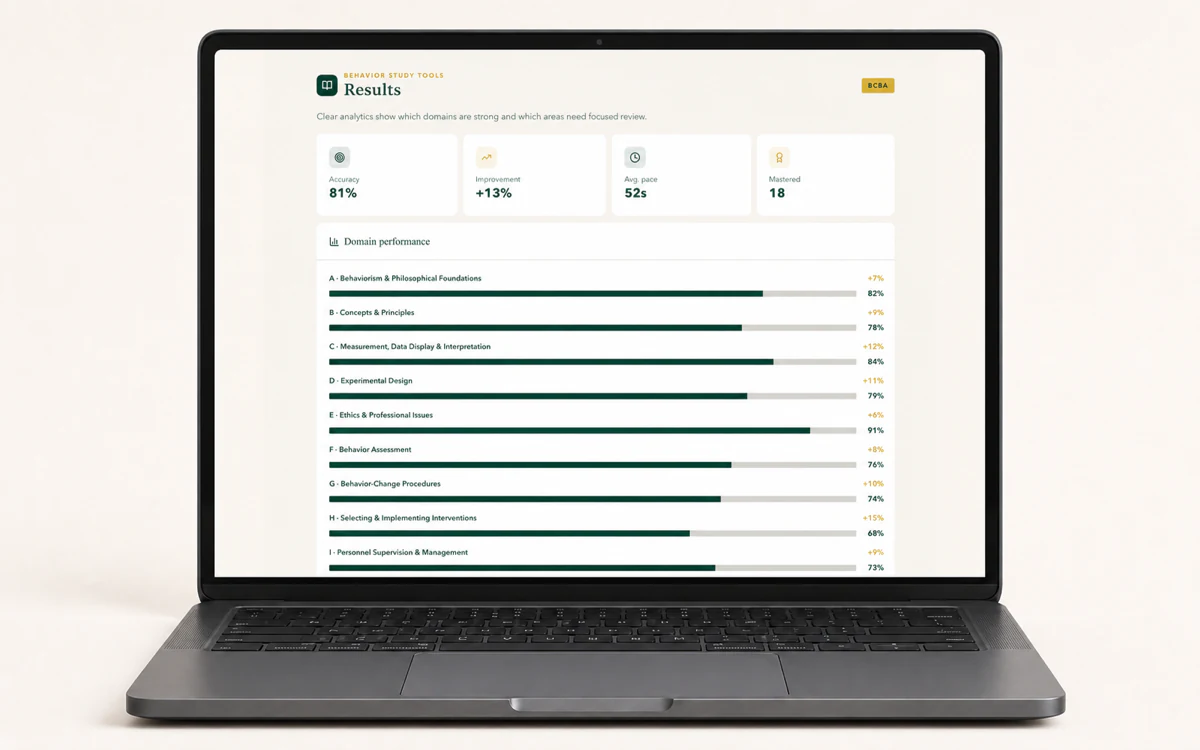
Why two candidates with the same mock score need different next steps
Mock exams are checkpoints, not verdicts. Two candidates both scoring 72% might differ completely: one missed high-weight procedural items under time pressure; the other missed low-weight foundations but finished early. The overall number hides the pattern you need for the next study block.
Useful follow-up evidence includes stable domain accuracy on mixed timed sets, finishing with time to review flagged items, and explaining why an answer is correct without reopening notes. If your score jumps only on a retake of the same form, you may be measuring recognition, not transfer on new items.
Behavior Study Tools reports domain-level results after mocks and shorter checkpoints so you can separate content gaps from pacing problems. No third-party mock certifies BACB exam eligibility.
Do not register for the BACB exam based on one third-party mock alone. Use domain results, pacing, and repeated mixed practice as inputs to your own study plan.
Score anatomy
Four signals to extract from every BCBA mock result
First, domain accuracy versus official exam weight from the BACB Test Content Outline (6th ed.). Underperformance in Domain G or F matters more than a miss in Domain A when both show the same raw percentage gap.
Second, pacing. Note unfinished items, rushed final sections, and whether you changed answers productively or under pressure. A strong content score with ten blanks suggests a different next block than a moderate score with steady timing.
Third, error type. Sort misses into concept gaps, misread scenarios, and trap distractors. Concept gaps often benefit from new retrieval practice in that domain; trap and misread patterns often benefit from explanation review and similar vignettes, even when the underlying concept felt familiar.
Fourth, consistency. One strong mock after a cram week is weaker evidence than three mixed sessions with a similar domain profile. Track trend, not peak.
- Domain accuracy vs. TCO weight
- Pacing and completion
- Error type (concept vs. trap vs. misread)
- Consistency across sessions
Worked example
How domain counts, timing, and error tags change the next block
Suppose you finish a full mock at 74% with 18 minutes remaining. Domain review shows Measurement at roughly 57% (4 of 7 scored items in that domain on this form), Ethics at 82%, and eight misses you tagged as misread scenarios rather than unknown concepts. Pacing was steady until the final 40 questions, where you rushed and changed three answers.
A reasonable next block: one Measurement-focused practice set, rationale review on the misread items, and a timed 20-question mixed set to practice pacing in the final quarter, rather than an immediate full mock retake.
If instead you scored 74% with four unanswered items, Measurement still weak, and most misses tagged as concept gaps in Experimental Design, the next block might prioritize Design reading plus applied questions before any pacing drill.
Study-action examples
Pattern-to-action examples (not readiness certifications)
These are study-planning examples, not validated readiness labels. Adapt them to your timeline, retake status, and supervisor guidance.
- Several high-weight domains below your target and pacing breaks down in the last quarter → focused domain practice and shorter timed sets before another full mock.
- Domain profile uneven but improving on mixed sets; pacing still tight → timed domain mini mocks plus rationale review on misses.
- High-weight domains stable across two mixed checkpoints; pacing acceptable with time to review flags → one full mock under exam conditions, then let that mock's domain and pacing results decide your next block (more mixed practice, targeted review, or supervisor exam-timing conversation), not a preset stop to further study.
- Stable domain profile, acceptable pacing, and you can explain answers without notes → discuss exam timing with your supervisor and confirm BACB registration windows on bacb.com.
Why this page stays here
Why this mock-score guide lives on behaviorstudytools.com
BehaviorSchool owns long-form schedule and school BCBA content. This page stays on the marketing site to interpret mock results and link directly to the Study free-mock checkpoint without duplicating those canonical guides.
Retake mistakes
Mock habits that inflate scores without improving transfer
Retaking the identical form within days often lifts the percentage without changing domain weaknesses. Immediate repeats measure item memory.
Studying only explanations from the mock without new retrieval practice feels productive but rarely moves timed performance.
Chasing a magic cutoff score from forums ignores that third-party mocks differ in difficulty and do not publish BACB pass thresholds.
Skipping review of saved or changed answers wastes the highest-value minutes after a mock. Those items reveal trap patterns you will see again in different scenarios.
- Avoid immediate identical-form retakes
- Pair explanation review with new questions
- Ignore forum cutoff myths
- Review changed and saved answers first
Use a free mock when you need new pacing evidence, not reassurance
Create a free account (no credit card) at study.behaviorschool.com/free-mock-exam/ when you are ready for a timed checkpoint. Finish, then review domain results before scheduling another.
01 Finish a timed mock
Complete a full or domain mini mock without pausing for content lookup.
02 Review domains first
Sort misses by domain and error type before looking at the overall percentage.
03 Assign one next block
Choose a single domain or pacing focus for the week, not a vague reread everything.
Mock score and study-planning questions
Does a mock score mean I am ready for the BCBA exam?
No third-party mock score guarantees a BACB result or certifies readiness. Use domain patterns, pacing, consistency on new items, and your own supervision context, not one percentage on one form.
Should I retake the same mock to raise my score?
Only if you need to test a specific pacing strategy, not to chase a higher number. Immediate repeats often measure memory of items rather than concept transfer.
What should I review first after a mock?
Start with high-weight domains where you missed applied scenarios, then review changed and saved answers. Leave the overall percentage for last.
How is a Quick domain check different from a mock checkpoint?
A Quick domain check is nine questions, one per domain, for orientation. A useful checkpoint comes from finished full mocks, domain mini mocks, and repeated mixed timed sets.
Where do I take a free BCBA mock?
Use https://study.behaviorschool.com/free-mock-exam/ for a free timed mock. A free account (no credit card) is required before you start; domain results show right after you finish.
Sources and verification
Related BCBA study guides
Best BCBA Exam Prep Apps in 2026: An Honest, Sourced Comparison
BCBA 6th Edition Test Content Outline: 9 Domains
BCBA Study Schedule: How to Plan 8, 12, or 16 Weeks of Exam Prep