BCBA 6th Edition Domain G
BCBA Domain G: Behavior-Change Procedures Study Guide
Domain G covers selecting and applying behavior-change procedures, including antecedent strategies, consequence procedures, skill acquisition, reduction, generalization, and maintenance.
- Domain G: Behavior-Change Procedures
- 25 scored questions, 14% of the exam
- Original study guidance, not copied exam items
See the full BCBA 6th edition task list (test content outline)
Answer first
What Domain G covers
Domain G covers selecting and applying behavior-change procedures, including antecedent strategies, consequence procedures, skill acquisition, reduction, generalization, and maintenance.
The BACB 6th Edition Test Content Outline assigns Domain G 25 scored questions, or 14% of the exam. The percentage is an official exam weight; the study sequence below is editorial guidance.
Worked vignette
Reason through an original practice scenario
A learner uses a communication card to request a break during independent work. The team wants to increase appropriate requests and reduce task-avoidance behavior. A strong plan reinforces the functional request, teaches it across relevant contexts, and monitors whether the skill generalizes rather than relying only on a reduction graph.
This is an original study vignette written for this guide. It is not a BACB exam item and is not copied from Cooper, Heron, and Heward.
Five practice prompts
Practice Domain G without memorizing answer choices
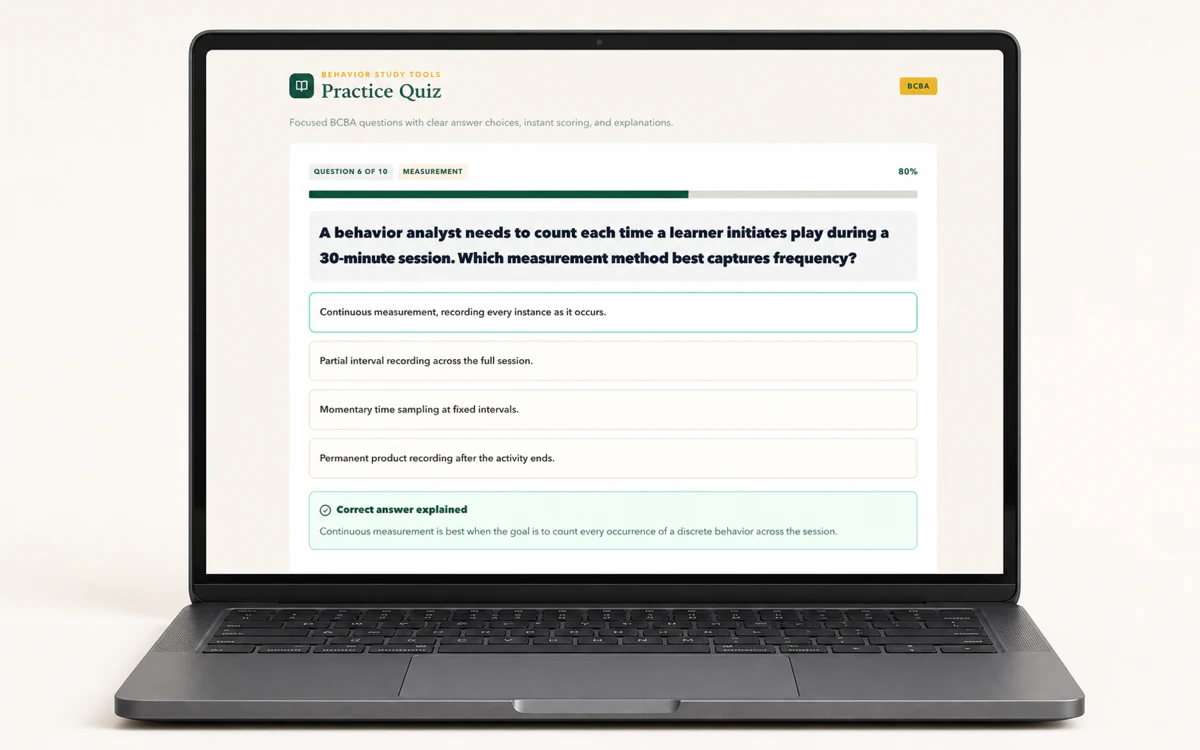
Answer each prompt in writing, then explain what evidence would change your decision. These are prompts for study, not full exam items.
- Identify the likely function and the replacement response.
- Which antecedent change could make the replacement response easier to use?
- What consequence would strengthen the replacement response without creating an unsafe dependency?
- How would you program generalization across people and settings?
- What data would show that the procedure should be continued or changed?
This week
A focused Domain G study block
Review one acquisition procedure and one reduction procedure. Write the target response, teaching sequence, consequence, generalization plan, and decision rule. Finish with a mixed set that asks you to identify the mechanism of change.
For textbook concepts used here, consult Cooper, Heron, and Heward (2020) and verify current ethics or exam requirements against the BACB source documents.
Common traps
What candidates commonly confuse in Domain G
Domain G questions often become confusing when a procedure name is treated as a complete answer. The same procedure can be appropriate or inappropriate depending on the function, the target response, the consequence, the teaching context, and the safety plan. Also separate skill acquisition from behavior reduction: a replacement skill needs its own teaching arrangement, not just the removal of an interfering response.
When two answers both sound reasonable, return to the evidence in the vignette. Ask what the item establishes, what it only suggests, and what the question is asking you to decide. This keeps a familiar term from pulling you toward an answer that is too broad, too certain, or out of sequence.
- Identify the likely function and the replacement response.
- Which antecedent change could make the replacement response easier to use?
- What consequence would strengthen the replacement response without creating an unsafe dependency?
Study method
How to build durable Domain G knowledge
Build one complete plan from a small case. Define the target and replacement response, identify the likely function, choose an antecedent arrangement, describe the teaching sequence, specify the consequence, and add a generalization check. Then change one surface detail and decide which part of the plan must change.
Use retrieval before rereading. Close your notes, explain the relation in plain language, apply it to a new case, and then compare your explanation with the source. Finish by writing one rule that would help you reject a tempting distractor on a future item.
- Explain the Domain G concept without the textbook open.
- Apply it to a new scenario with different surface details.
- Name the evidence that would change your decision.
- Review a mixed set after the focused block.
Transfer
Move from Domain G recognition to applied decisions
To transfer Domain G knowledge, practice choosing procedures without a list of labels in front of you. Ask whether the plan makes the replacement response efficient, whether the consequence can maintain it, and whether the learner can use the skill with new people, materials, and settings. Review reduction choices for dignity, risk, and function.
A domain guide is useful only if the reasoning travels. Mix this domain with the other eight, remove the topic label, and ask yourself which evidence deserves the most weight. Then review whether your answer protects the client, fits the data, and answers the stem rather than a different question.
- Practice with a short untitled vignette.
- State the decision before looking at answer choices.
- Compare the strongest two options by evidence and fit.
- Record the rule that separates them.
Checkpoint
Know when to leave focused Domain G practice
Stay with focused practice long enough to explain the concept and apply it to more than one surface form. Then leave the single-domain block on purpose. A correct answer inside a labeled guide can reflect recognition, while an untitled mixed question tests whether you can identify the relevant relation yourself.
Use a short mixed set after this guide and compare three signals: accuracy, decision time, and rationale quality. If accuracy holds but explanations are vague, continue retrieval. If explanations are strong but decisions are slow, practice timed discrimination. If the pattern changes when the topic label disappears, add more transfer practice.
Return to this page when your error log names a specific confusion. Do not reread the whole guide automatically. Find the distinction, explain it without notes, write a new example, and test it again in mixed practice.
A useful checkpoint is specific enough to change tomorrow's study block. Instead of writing that you need to know Domain G better, write the observable task you will perform: define the relation, select the measure, choose the ethical next step, explain the procedure, or defend the intervention decision. Specific tasks make progress easier to see and keep review connected to applied reasoning. Add the source or practice result that supports your conclusion, and note what evidence would make you revise it. That final step turns a confident guess into a reviewable study decision.
- Explain the concept with no notes.
- Apply it to two different case settings.
- Answer one untitled mixed question.
- Review the strongest distractor.
- Choose a next action from the evidence.
Domain G study questions
How many BCBA exam questions come from Domain G?
The 6th Edition TCO assigns Domain G 25 scored questions, or 14% of the 175 scored questions. The BACB can update exam documents, so verify the current outline.
Are the prompts on this Domain G guide actual exam questions?
No. They are original practice prompts for reasoning and discussion, not copied or represented BACB exam items.
How should I practice this domain?
Use the domain-intent practice link on this page, review why each answer is stronger than its distractors, and use a full mock later for pacing across all nine domains.
Sources and verification
Related BCBA study guides
BCBA Domain B: Concepts and Principles Study Guide