BCBA exam facts
BCBA Exam Pass Rate by Year: 2022 to 2025
Review official BACB BCBA exam pass rates by year, then use your own domain accuracy, pacing, and rationale review to choose the next study block.
Updated October 2026 with BACB's 2025 data. Refresh this page annually after BACB posts the prior year's examination and university program figures.
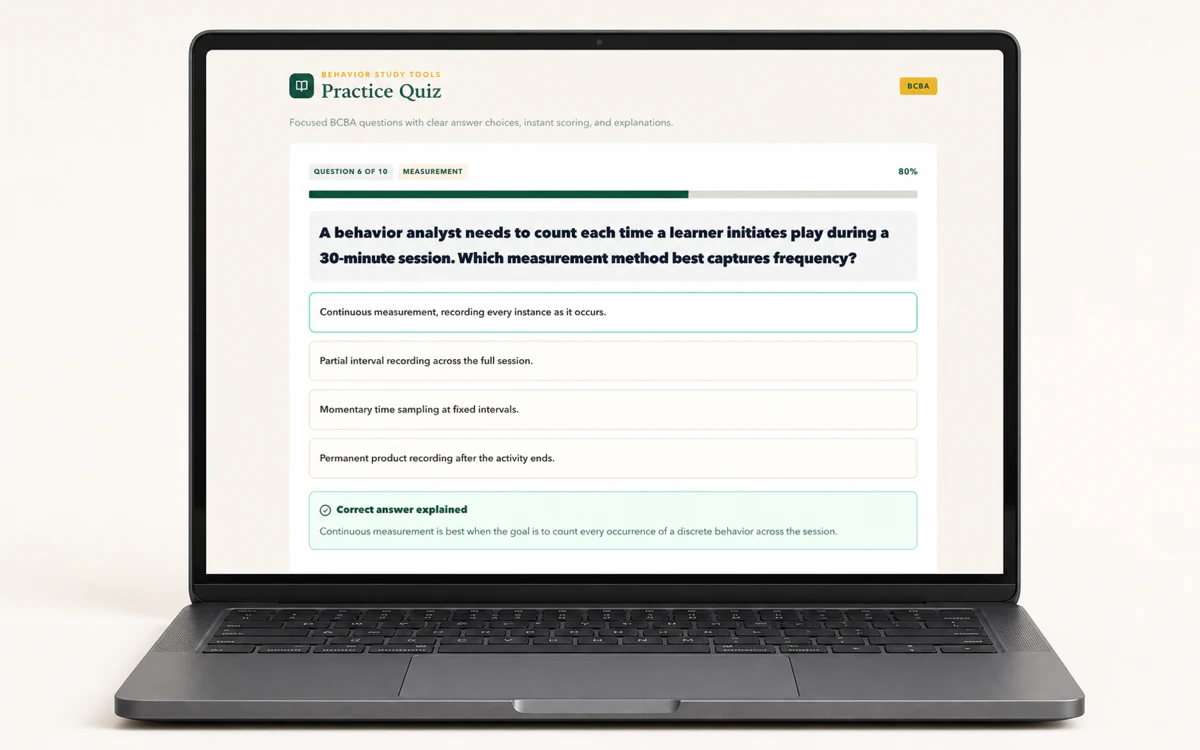
Try the free 185-question mock
- BACB-sourced figures
- BCBA 6th Edition information
- Free mock with a free account
See the full BCBA 6th edition task list (test content outline)
The short answer: pass rates describe groups
The BACB reported a 51% first-time pass rate and a 23% retake pass rate for 2025.
The table below shows first-time and retake percentages from 2021 through 2025. These are historical group figures, not a personal probability or readiness cutoff.
Use the current BACB source pages to verify figures, then use your own domain results and pacing evidence to plan.
Context is useful. Your repeated practice pattern is the better guide for your next study decision.
How to read the table
What the 2025 first-time pass rate means
In 2025, 9,955 people took the BCBA exam for the first time, and 51% passed. That is a result for a defined group in a defined year. It is useful context, but it is not a forecast for your attempt.
The exam has 185 multiple-choice questions in a four-hour session. The BACB sets the passing standard with a criterion-referenced modified Angoff method and equates forms for difficulty. In plain language, your result is evaluated against the standard rather than against how other candidates perform.
The table includes 2021 through 2025 so you can see the year attached to every percentage. The first-time rate moved from 60% in 2021 to 51% in 2025, with the intervening figures shown directly rather than summarized as a trend. The 6th Edition Test Content Outline took effect on January 1, 2025. The BACB data alone does not establish why the rate changed, so do not treat timing as proof of a cause.
Use a pass rate to understand the exam context, then use your own domain accuracy, timing, and rationale quality to decide what to study next. Those personal signals are closer to your current preparation than a population percentage.
Retake context
Why a retake percentage needs careful interpretation
In 2025, 13,196 candidates retook the exam, and 23% passed. The retake percentages in the table are 28% for 2021, 24% for 2022, 23% for 2023, 25% for 2024, and 23% for 2025.
The published figures do not tell us why retake candidates pass at a different rate, so this page does not invent a reason. A score report can still give you a practical starting point. It shows percent correct by content area, but each area contains relatively few items, so treat it as a directional signal rather than a complete diagnosis.
A sensible retake plan uses the report to choose an opening review block, then checks the pattern against missed-question rationales, slow correct answers, and performance on mixed practice. Study the full content before another attempt. Focusing only on one reported area can leave other decision skills untested.
Program data
How university program rates differ from exam-wide rates
The BACB also publishes pass rates for university training programs. Those figures answer a different question from the exam-wide first-time and retake rates: they describe outcomes associated with groups of candidates reported by programs.
For 2025, the published program data reports a mean pass rate of 79.3% for 25 qualifying ABAI-accredited programs and 53.2% for 179 other reported programs. It also reports that the 10 largest programs accounted for 54.7% of first-time candidates and had a mean program pass rate of 42.9%.
These are group averages. They do not prove that a program type causes a result, and they do not predict the outcome for one student. Read the program's own rate, cohort context, and reporting notes together. The BACB describes program pass rates as historical outcomes, not rankings, endorsements, or guarantees.
If you are comparing programs, keep the questions separate: What does the program report? How large and recent is the reported group? What support is available to students? A program percentage should be one piece of that review, not a shortcut for deciding whether you personally are ready for the exam.
Study meaning
What the numbers mean for your preparation
A 51% first-time rate means that about half of the first-time candidates in the reported 2025 group did not pass. It can feel heavy to read, especially when you are balancing coursework, fieldwork, work, and family. The most useful response is to turn the number into a plan rather than a prediction.
Start with the current BCBA test content outline. Map your study blocks to all nine domains, giving more repetitions to high-weight areas where your accuracy or speed is still inconsistent. Then use mixed sets so you practice switching from measurement to ethics, assessment, intervention selection, and supervision without a chapter heading telling you what concept is coming.
Review the rationale for every missed item and every answer that took too long. Write the fact, distinction, or decision rule that would have made the item easier. This makes a practice session produce a reusable rule instead of only a score.
Use a full 185-question mock as a pacing and endurance checkpoint when your targeted review has produced a stable pattern. A mock does not certify readiness, and no study method can promise a pass. It does show whether you can apply your reasoning across a long session and where the next review block should begin.
Action plan
Five evidence-based ways to use pass-rate context
Study all the content. Build from the official outline and keep smaller domains in rotation. A lower domain weight is not permission to skip that domain.
Practice under time limits. The real exam is 185 questions in four hours. Rehearse pacing in shorter sets first, then use a full mock to test endurance and the effect of fatigue on your decisions.
Use domain results as signals. Compare accuracy, pace, and error type by domain. Do not let one overall percentage hide a recurring confusion between two related concepts.
Make rationale review active. For each item, explain why the correct answer fits the evidence and why the strongest distractor does not. If you cannot explain the distinction, mark the topic for another retrieval block.
Plan a retake with a sequence. Start with the score report, add targeted domain practice, mix the domains, and return to a full mock when you need pacing evidence. The pass-rate table supplies context; your own repeated performance supplies the next decision.
- Use the official BACB examination information page for the current published figures.
- Keep first-time and retake percentages in separate columns.
- Treat program rates as historical group outcomes, not personal guarantees.
- Review all nine domains, even when one area looks weakest.
- Use a full mock for pacing and endurance, not as a certification label.
Year by year
BCBA first-time and retake pass rates by year
These are historical percentages reported by the BACB for each calendar year and attempt type. They describe groups, not an individual candidate's probability.
| Year | First-time pass rate | Retake pass rate |
|---|---|---|
| 2021 | 60% | 28% |
| 2022 | 55% | 24% |
| 2023 | 56% | 23% |
| 2024 | 54% | 25% |
| 2025 | 51% | 23% |
BCBA pass-rate questions
What was the BCBA first-time pass rate in 2025?
The BACB reported a 51% first-time pass rate for 2025, based on 9,955 first-time candidates.
What was the BCBA retake pass rate in 2025?
The BACB reported a 23% retake pass rate for 2025, based on 13,196 retakes.
Does the BCBA pass rate predict whether I will pass?
No. A published pass rate describes a group for a particular year and attempt type. Use your own domain accuracy, pace, rationale review, and mock performance to plan.
Why are retake pass rates different from first-time pass rates?
The published figures show different group outcomes, but they do not establish why the groups differ. Do not infer a cause from the percentages alone.
Should I study only the weakest areas after a failed attempt?
Use the score report to choose where to begin, then study the full content. Each content area has relatively few items, so the report is a direction for review rather than a complete map.
Should I compare a university program rate with the overall exam rate?
Read them as different types of historical group data. The BACB advises interpreting program pass rates on their own terms rather than using them as a ranking or individual guarantee.
How should I use pass-rate data while studying?
Use it as context for planning, not as a personal probability. Let domain performance, pacing, repeated error patterns, and full-mock endurance determine your next study block.
How often should this page be updated?
The page is refreshed annually after the BACB publishes the prior year's examination and university program data. Verify the current BACB pages before relying on a figure.
Sources and verification
BCBA examination pass rates for university training programs: 2025
References
APA-style sources
- Behavior Analyst Certification Board. (n.d.-a). Examination information. Source link
- Behavior Analyst Certification Board. (n.d.-b). University pass rates. Source link
- Behavior Analyst Certification Board. (n.d.-c). BCBA examination pass rates for university training programs: 2025. Source link
Related BCBA study guides
Free BCBA Practice Exam: 6th Edition Questions
BCBA Test Content Outline (6th Edition): 9 Domains A to I
BCBA Study Schedule: How to Plan 8, 12, or 16 Weeks of Exam Prep
Continue studying
BCBA pass rates are historical data, not a personal guarantee