BCBA retake help
Failed the BCBA Exam? A Retake Study Plan
After a failed BCBA exam attempt, give yourself a short reset, then use the score report and repeated error patterns to build a retake study plan.
Try the free 185-question mock
- BACB-sourced figures
- BCBA 6th Edition information
- Free mock with a free account
See the full BCBA 6th edition task list (test content outline)
First 48 hours
Separate the result from your identity
A failed attempt is an outcome to analyze, not a complete description of your ability or future. Give yourself enough space to process the result, then move from general discouragement to specific observations. Avoid rebuilding your entire study plan from memory of how the test felt.
Write down what you know while the experience is fresh: where you felt slow, which question types felt unfamiliar, whether fatigue changed your decisions, and which domains seemed hardest to retrieve. Keep those observations separate from the official score report until you can compare them.
The goal of this first step is not to decide your next test date. It is to create a calm record that can be checked against evidence.
Score report
Turn the report into a starting hypothesis
Use the content-area information to identify where to begin, but do not treat a single percentage as a complete weakness ranking. Each area has relatively few items. A reported low area may deserve attention, while a reported stronger area can still contain a recurring confusion that the report cannot show.
For each domain, add three notes: what the report suggests, what your practice data shows, and what you still need to verify. This keeps the score report in its proper role. It is a directional signal that helps you choose a first block, not a substitute for item-level reasoning.
Use the BCBA 6th Edition Test Content Outline to keep the whole exam in view. A retake plan should begin with the weak pattern and then return to all nine domains.
Error analysis
Sort misses into useful categories
Review missed practice items and classify the error. A concept error means you could not explain the relation. An application error means you knew the term but missed how the vignette changed the decision. A reading error means you answered a nearby question. A pacing error means you eventually knew the answer but spent too long getting there.
Also review slow correct answers. If you reached the right choice only after eliminating every option one by one, the concept may not yet be fluent enough for a long session. Mark it for retrieval practice rather than assuming the correct response means the skill is finished.
For every item, write why the correct answer fits and why the strongest distractor fails. That one sentence becomes a study rule you can test in a new case.
- Concept gap
- Application or discrimination error
- Question-reading error
- Pacing or endurance error
- Ethical or evidence boundary error
Targeted block
Practice the weakest pattern before another full mock
Start with the domain or decision type that appears most often in your evidence. Use focused questions, but do not stop at the answer key. Explain the mechanism, identify the evidence, and state what would change your decision.
Keep the block narrow enough to review deeply. Ten rushed questions can produce less learning than a smaller set followed by careful rationale notes. When the pattern improves, mix in a neighboring domain so you learn to discriminate without a heading announcing the topic.
Use the domain guides for focused review of Concepts and Principles, Ethics, or Behavior-Change Procedures. Use the study schedule when you need a calendar sequence rather than another isolated set.
Pacing checkpoint
Use the free mock to test the whole retake plan
Return to a full mock after targeted practice has produced a stable pattern. The free BCBA mock has 185 questions and a four-hour time limit, so it can show whether accuracy holds while you read, decide, and continue through a long session. A free account is required and no credit card is needed.
Review the mock in three passes. First, inspect incorrect answers. Second, inspect slow correct answers. Third, compare the domain pattern and pacing pattern with the earlier evidence. The comparison matters more than one isolated mock percentage.
If your accuracy is better but your pace collapses late in the session, the next block is not simply more content review. It may need shorter timed sets, decision rules, and practice continuing after a difficult item.
Retake plan
Build a weekly sequence you can actually repeat
A workable retake plan has a repeating rhythm: review one evidence-based priority, practice it deeply, mix it with other domains, review rationales, and check pacing at planned intervals. Put the full BCBA test content outline on the schedule so the plan does not become a single-domain tunnel.
Each week, choose one measurable study action. You might explain a concept without notes, complete a timed set, analyze a graph, write an ethics decision sequence, or produce a function-linked intervention plan. The action should create evidence you can review, not just time spent reading.
When you choose a new test date, use your repeated performance and practical constraints. No page or mock score can promise a pass. A better plan is one that makes the next decision visible and gives you enough practice to evaluate it.
Failed BCBA exam questions
What should I do after failing the BCBA exam?
Review your score report, identify weak domains and error patterns, then use targeted practice before another full mock.
Should I take another mock exam right away?
Take one right away only if you need a baseline. If your weak areas are clear, start with targeted domain practice and use a mock later for pacing.
Can free practice help after a failed attempt?
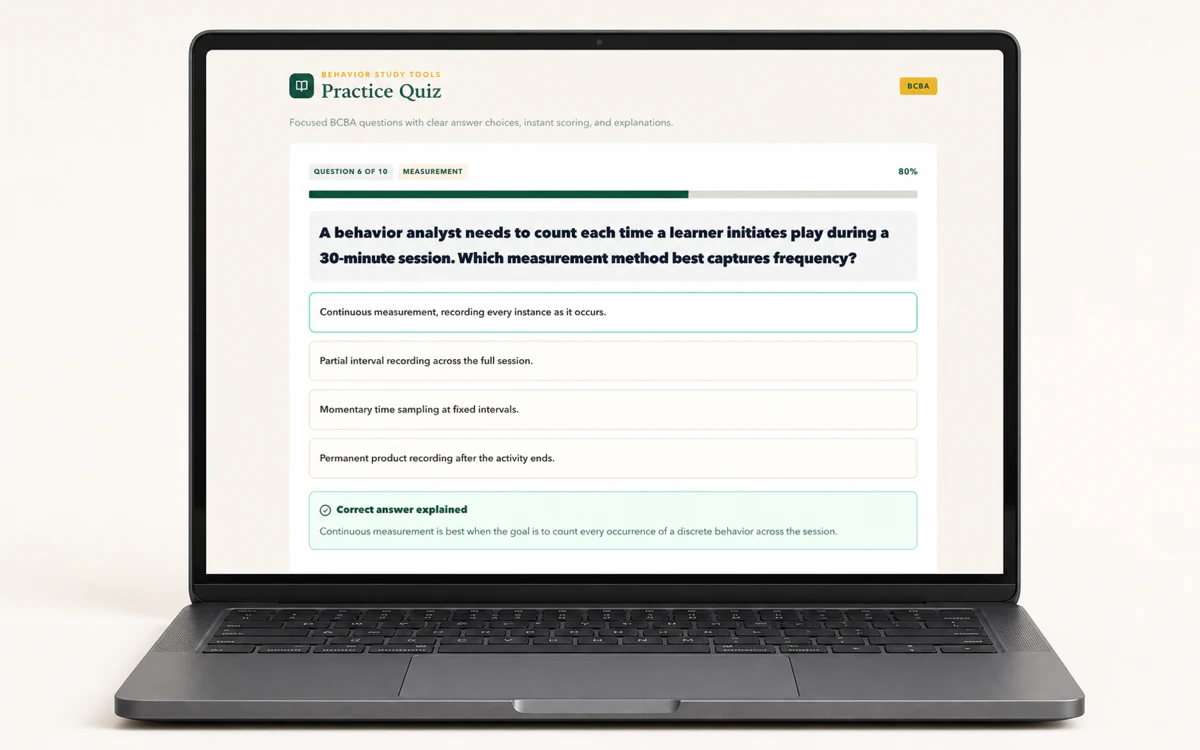
Yes. Use the free 9-question practice for orientation or the free 185-question mock for a full pacing checkpoint, and review the reasoning behind each answer.
Should I study only the domains shown as weak?
Use the score report to choose where to begin, then study the full BCBA test content outline. A few items in one content area cannot serve as a complete map of every weakness.
How should I review a missed practice question?
Explain why the correct answer fits the evidence, why the strongest distractor does not, and what rule you will apply to a new vignette.
What if I knew the answer but ran out of time?
Track slow correct answers as pacing errors. Use shorter timed sets, practice a decision rule, and return to a full mock to see whether the pattern improves across the session.
When should I take another full mock?
Use targeted domain practice first when your weak patterns are clear. Take another full mock when you need evidence about pacing, endurance, and whether the improvement transfers across all nine domains.
Can a mock score tell me that I am ready?
No. A mock is a checkpoint for accuracy, pace, endurance, and rationale quality. Use those signals with your study history and practical constraints rather than an invented guarantee.
Sources and verification
Related BCBA study guides
Free BCBA Practice Exam: 6th Edition Questions
BCBA Test Content Outline (6th Edition): 9 Domains A to I
BCBA Study Schedule: How to Plan 8, 12, or 16 Weeks of Exam Prep